





Putting together matching ski outfits for children
Children's ski clothing should fit well, allow for movement, and work effectively together for everyday use on the mountain. Compare jackets, pants, and underlying layers based on body measurements and actual use. Here you will find guidance on growth, thermal insulation, and transitions to gloves and ski boots, so that individual pieces can be combined into a coherent and well-coordinated winter outfit.


Choosing the right combination of children's ski clothing
Children's ski clothing should allow for movement, provide adequate coverage, and be practical to handle on the mountain. For this to happen, the jacket, trousers, and underlying layers must fit together. Start with the child's actual needs: How long will they be outside, how active are they, and what clothing do they already have? A thicker appearance alone does not answer these questions. The right equipment comes from a coordinated layering system and a size that fits the child.
A ski outfit is also more than the sum of its beautiful individual parts. Sleeves and gloves form a transition, trousers connect to boots, and the collar must harmonize with other equipment. Consider these connections together. A new item should integrate into the planned system rather than creating new fit problems elsewhere. The design should appeal to the child; function and movement remain equally important selection criteria.
Prioritize body size and movement over age recommendations
Age recommendations can provide guidance, but they do not replace body measurements. Children of the same age can be of different heights and proportions. Therefore, compare the sizing chart of the respective brand and the cut of the specific model. Shoulders, back length, hips, and leg length play different roles depending on the item. A single number does not fully explain how a jacket or trousers will fit the child and behave during movement.
Have the child raise their arms, move forward, and squat. The jacket should not immediately ride up too far, and the trousers should not uncomfortably pull at the knees or seat. In a relaxed standing position, such differences may remain invisible. The correct size allows for usual movements without constantly having to adjust hems or sleeves. A consciously loose fit is different from a randomly oversized size.
Consider growth without buying too large
Children grow, but significantly excess length is not an automatic solution for longer use. Sleeves that are too long can cover hands, a wide waistband can slip, and too much fabric at the leg can bunch up at the shoe. Plan for sensible room according to the specific fit. If a model explicitly has adjustable or grow-with-me elements, these can be considered. However, such features should not be assumed for all children's ski clothing.
The intended use of the item is crucial. Clothing that might only fit properly sometime in the future may not perform well for its current task. Therefore, compare the existing measurements with the actual requirements and keep mobility in mind. A small design compromise can be easier than a significantly unsuitable length. The right winter equipment is geared towards the child and not solely towards the desired period of use.
The first layer directly on the skin
The first layer of clothing lies beneath the other items and should fit comfortably on the body. It should not unnecessarily press, but also should not form large wrinkles. Choose the material and thickness according to the planned layering and the child's thermal sensation. A blanket rule that the thickest underwear is necessary for every ski day is of little help. Movement and the layers above influence the overall feeling.
Pay particular attention to transitions at the waistband and lower legs. Several thick closures at the same spot can be noticeable. The first layer should match the trousers and the intended socks. If material blends or special functions are described, these apply to the respective item. A well-known fiber name alone does not explain the entire thermal build-up or universal suitability for every temperature.
Adding an intermediate layer purposefully
An additional layer over the underwear can contribute warmth. For this, the outer jacket needs enough room, especially at the shoulders and upper arms. Too much bulk can restrict movement, even if each piece individually feels soft. Therefore, compare the combination with the garments that are actually intended to be worn underneath. A quick try-on without the planned intermediate layer can give an incomplete picture of the later fit.
Collars and zippers should also match. Several tight closures directly under the chin can be annoying. An additional layer does not automatically need to have a high collar or many details. Its role in the system is crucial. Choose it so that it complements the need for warmth and moves appropriately under the jacket. More layers are not inherently better if their transitions become disorganized or too tight.
Ski jackets: Coverage, pockets, and sleeves
A children's ski jacket should cover the upper body according to its shape and retain sufficient length during movement. The hem must match the trousers. Jackets that are too short or ride up significantly can alter the transition, while a distinctly too long shape also influences movement differently. Compare the silhouette in conjunction with the child. A product image shows a way of wearing, but not an identical length for every body size.
Pockets are particularly useful if they are easy to reach and understand. An additional zipper is not an advantage if its position is impractical for use. Consider what items actually belong in the jacket. An explicitly provided ski pass pocket can fulfill a specific task; it should not be assumed solely based on a typical ski aesthetic. The specific features of the model remain the standard for comparison.
The sleeve cuff connects the jacket with the children's gloves. A short cuff and a long gauntlet require different transitions. Check whether both parts lie appropriately over each other and can be handled. Several tight adjustments at the same spot can be uncomfortable. A clear closure helps more than many individual details that are not coordinated with each other or need to be constantly adjusted when putting on.
Ski trousers: Waistband, knees, and lower leg
For trousers, the hip area and knee movement are central points. Have the child sit and bend their legs instead of only judging the fit while standing upright. Trousers should not stay in position solely by a tightly fastened waistband. Suspenders or other adjustments can be an addition for appropriate models, but they do not replace a suitable basic size. Ensure that the desired shape is maintained on the child.
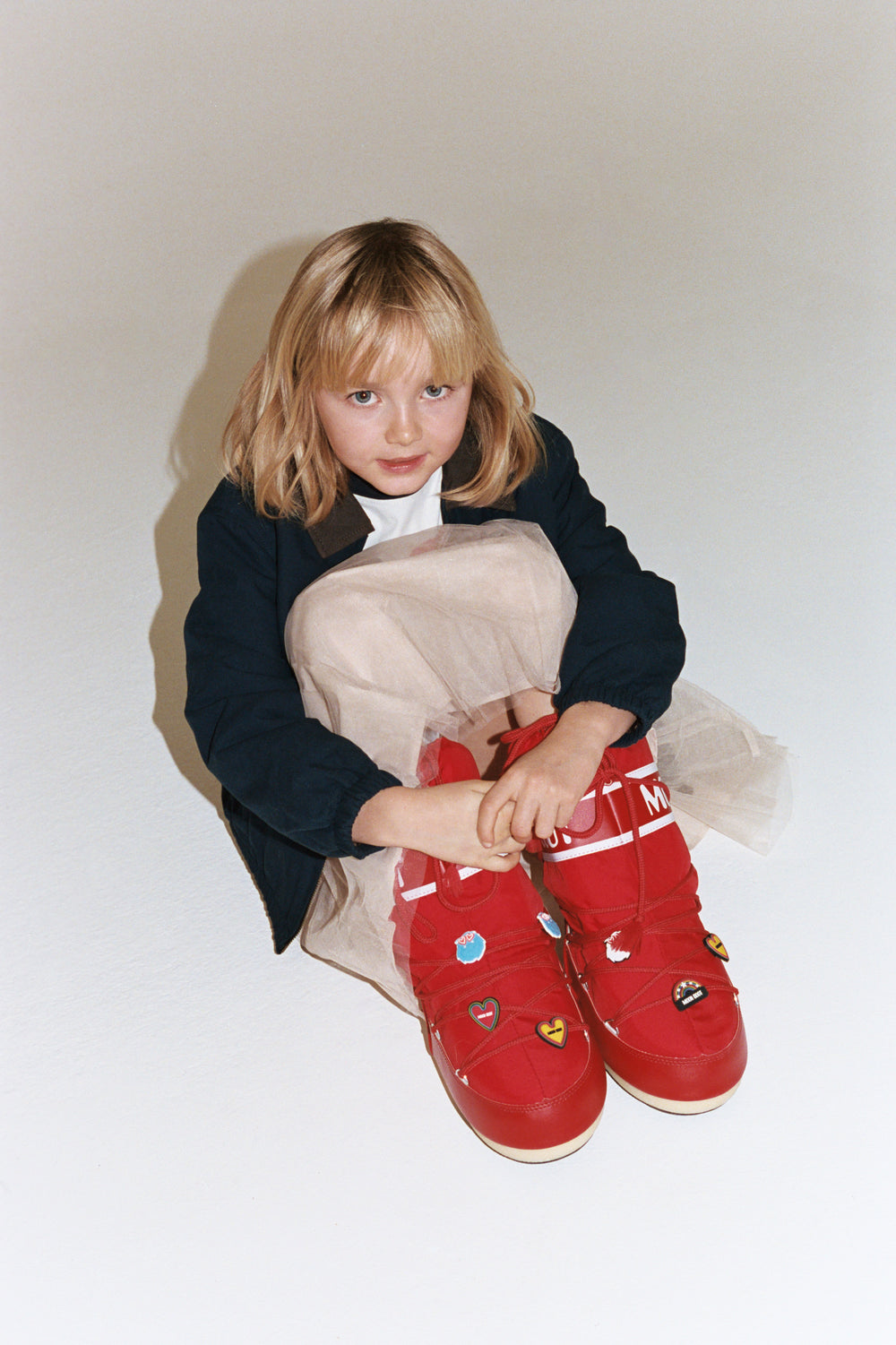
At the lower leg, the trousers must match the intended equipment. The cuff should not lie on the boot as a large pile of fabric. Described snow gaiters or reinforcements belong to the specific construction and each have their own purpose. They are not automatically present in every item. Therefore, compare the length with the children's ski boots actually used, without altering their fit with additional layers of fabric.
Read weather function and warmth separately
Water-repellent, waterproof, and windproof describe different properties. A water-repellent surface is not a universal proof of protection against continuous wetness. For a waterproof described construction, material and workmanship are jointly relevant, such as seams and closures. A sporty brand name is not sufficient proof. Choose according to the concretely stated properties of the model and the planned use.
Warmth, in turn, arises from the layering of several layers and any existing insulation. A filling does not automatically make a jacket waterproof. An outer protective layer does not have to provide all the warmth itself. This distinction helps to combine clothing meaningfully. Ask about the purpose of each part: first skin layer, additional warmth, or outer function. This keeps the selection understandable and prevents a single number from dominating all decisions.
Consider putting on and self-reliance
Children's ski clothing is often put on in several steps. Fasteners should be suitable for the intended handling. Consider which steps the child can perform themselves and where assistance is needed. A large, easily accessible grip can function differently than a small, concealed closure. The more practical solution is not automatically the one with the most features, but the one whose details can be used meaningfully in the actual process.
Taking off after sports is also part of it. Several layers hooked into each other or hard-to-recognize closures can unnecessarily complicate the process. Therefore, mentally put on and take off the combination in its sequence. This reveals transitions that are not visible in the product image. A suitable selection supports everyday life on the mountain without turning every piece of clothing into an extensive technical task.
Helmet, goggles, and other equipment retain their own function
A ski helmet must fit according to the manufacturer's specifications. A thick hat or additional clothing must not arbitrarily alter this fit. A hood must also be suitable for the specific combination if it is to be used with the helmet. The mere size of the hood is not proof. Clothing complements the equipment through appropriate transitions and does not replace an independent fit test of the protective products.
Other children's accessories can supplement coverage and handling. It remains crucial that each part has a clear role. A neck gaiter, goggles, or gloves are not automatically interchangeable with a different size or any model. Compare the connection to the clothing and the respective manufacturer's specifications. A visually coordinated outfit can be pleasing, but it should not force an unsuitable combination for design reasons.
Choose colors that the child likes to wear
Children can meaningfully participate in decisions about color and design. A preferred shade or a recognizable detail can help to assign their own clothes in everyday life. However, the design choice complements the appropriate size and function. A strong color is not a complete safety concept and does not replace suitable equipment. Therefore, consider the appearance as a personal part of the selection, without deriving additional technical properties from it.
Jacket and trousers do not have to be identically designed to match. A recurring color or a consciously calmer counterweight can create a connection. First, check the functional transitions and then the desired effect. This way, the child can get their own combination that is also practically understandable. The complete children's section provides the overarching entry into clothing, shoes, and complementary items.
Care and a clear set of equipment
Observe the care instructions for each item. Underwear, intermediate layer, and outer ski clothing can have different washing and drying requirements. Similar colors or the same manufacturer do not automatically mean identical procedures. Empty pockets and note closures before the intended care. Additional impregnations or other treatments should only be carried out according to the specific manufacturer's instructions and not based on a general assumption about the material.
A good selection can ultimately be clearly explained: appropriate body measurements, sufficient movement, sensible warmth build-up, and functional transitions. Start with these points and then add design and details. A new item should improve existing equipment or close a specific gap. This is how children's ski clothing is created that fits the intended use and can be sensibly combined in daily use on the mountain.
04At FREUDENHAUS
05Questions about the category