






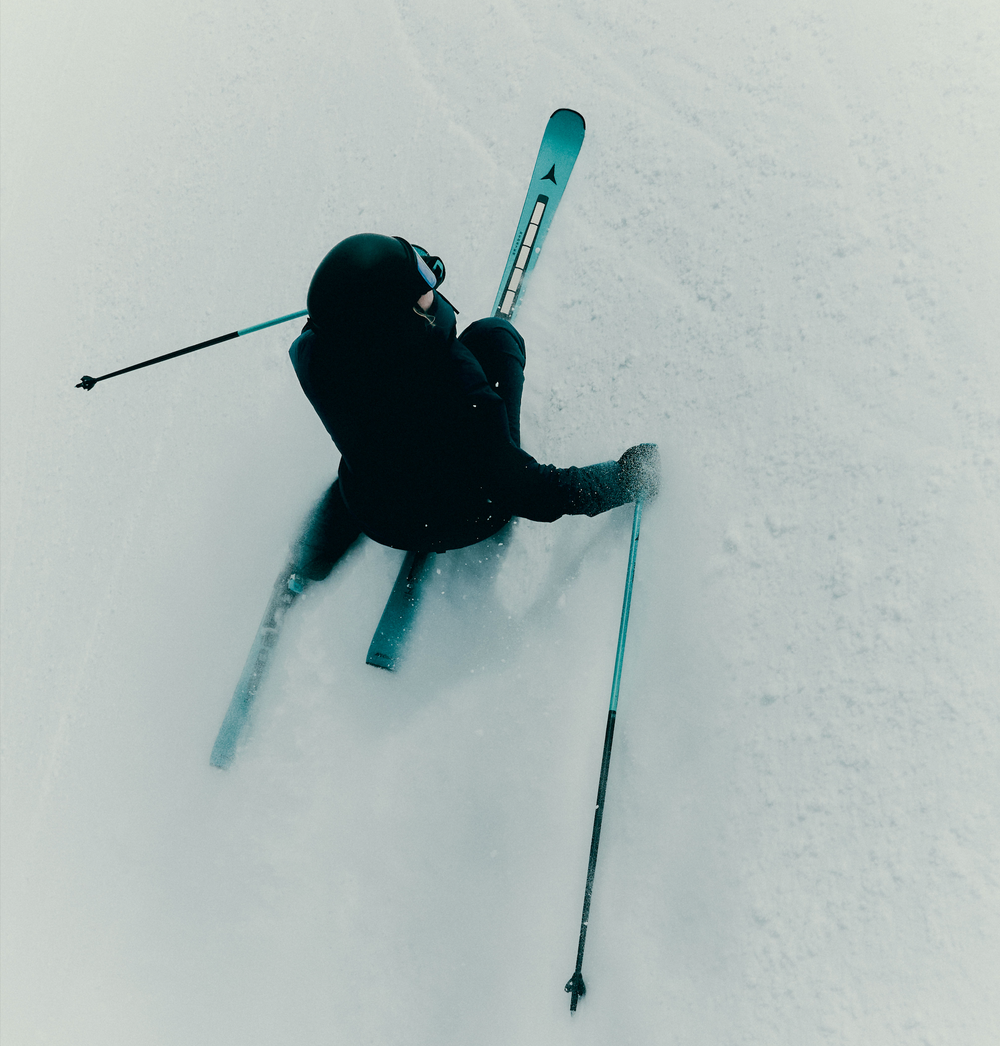

Komperdell Ski Poles: the perfect grip for your ski day
With ski poles, you often only notice differences once you're holding them: in the grip, in the strap, and in how the pole moves. Komperdell combines these details with extensive pole expertise. Here you'll find guidance for your selection, from the Pure Carbon Freudenhaus to fundamental questions about length and construction.
02Discover
Categories.

03One handle for many movements
Your ski pole.
A conscious choice.
Komperdell: Pole Expertise with Alpine Roots
Komperdell is closely associated with Mondsee in Austria. The company's history describes the location in the Salzkammergut as the brand's center since the 1980s. In addition to this origin, the specialization in different pole concepts is particularly interesting for your selection: an alpine pole must fulfill different tasks than a model for long ascents or a tour with changing grip positions.
This brand page focuses on the selection for a day of skiing. It's worth looking at poles not just at the very end of your equipment planning. Their length and grip contact accompany every descent. If you consciously choose a ski based on your riding style, you should also check with the pole whether it can be comfortably handled with gloves and suits your predominant use.
Pure Carbon Freudenhaus as a Concrete Reference Point
The model name Pure Carbon Freudenhaus highlights a special connection to the FREUDENHAUS selection. If you are looking for this specific pole, compare the offered length and the details of the respective version. A name alone does not describe all components: grip, strap, basket, and tip deserve as much attention as the shaft. The detailed view of the model is the right starting point for this.
Even with a carbon model, a single material term does not determine whether it is right for you. Consider the design and the overall feel. A grip might feel comfortable without a glove, but offer too little space with your thick ski glove. Conversely, a larger grip contour might require unnecessarily much force to hold for a small hand. Precisely these differences should become visible during comparison.
For an overview of other shapes and designs, the Ski Poles category helps. There you can compare the same length across different models. Such a comparison is more meaningful than comparing a short, lightly equipped pole with a longer, differently constructed variant and attributing the difference entirely to the material.
Choosing the Right Length for Your Stance and Use
When choosing pole length, start with your body height and intended use. Manufacturer recommendations provide a first guideline. After that, your actual skiing stance matters: the pole should be easy to maneuver without constantly shrugging your shoulder or unnecessarily stretching down when planting. A mere number on the label only incompletely describes this movement.
If you already have a pair of ski poles, their length is a useful reference. Note whether you find them suitable, rather short, or rather long, and in which situations this is noticeable. A comparison with an adjacent length thus becomes more concrete. Do not automatically adopt the length from another sport, because the movements involved in alpine skiing and, for example, hiking are different.
For children and young people, body height, grip size, and learning stage should be considered together. A significantly too long pole is not a sensible reserve for several upcoming winters. Likewise, not every early learning step on skis is an occasion for their own poles. If the appropriate use is still open, the assessment of a ski instructor can help before you commit to a specific model.
Fixed Length or Adjustable Construction?
A fixed-length pole offers a clearly defined shape. You choose the right length once and don't have a length adjustment that needs to be checked before descending. This can be a straightforward solution for predominantly piste skiing. The crucial thing remains that the chosen length really fits and is not just selected because it is offered with a certain design.
Adjustable poles, on the other hand, allow for different lengths within a given range. In the Komperdell brand world, Vario concepts, among others, are available for this. They are interesting if you consciously need different settings. Then, check not only the maximum range but also whether your usual length is within it and how the locking mechanism should be operated and controlled according to the manufacturer.
This distinction does not mean that every carbon model is adjustable or that a Vario pole automatically fits every use. Design and material are two separate characteristics. For a purely piste selection, a fixed length can be completely logical; for other requirements, additional functions may become more important. Choose the construction based on a specific benefit, rather than collecting as many features as possible.
Carbon, Shaft, and Swing Feel
Komperdell showcases, for example, the White Knight and Dark Knight models in its alpine carbon world. For these, the manufacturer specifies a carbon shaft and a shaped foam grip. Such examples clearly show that shaft and contact surfaces are considered together. They serve as an orientation within the brand world; a different Komperdell model will have its own equipment specifications.
When comparing weight, pay attention to whether a single pole or a pair is meant and to which length the number refers. Without this information, two values are only partially comparable. The weight distribution also influences how a pole feels in your hand. A pure ranking by gram count therefore leaves important differences in the grip and the rest of the construction open.
For your everyday use, it also matters how carefully you transport your equipment. Do not clamp a pole uncontrollably under heavy luggage and do not use it as a lever to loosen other equipment. Check the shaft and connections after any unusual stress. If you suspect damage, it should be expertly assessed before the pole is used further. This applies regardless of the material designation.
Assessing Grip and Strap with Gloves
The grip contour determines where your fingers rest and how you hold the pole. A distinct shape can feel very suitable if it matches your hand. For a different hand size, a smoother grip design might be more comfortable. Therefore, don't just briefly hold the pole with bare hands, but if possible, with the gloves you intend to wear on the slopes.
Pay attention to whether you can hold the grip relaxed. If your fingers are spread very wide or thick seams of the glove are uncomfortably positioned between your hand and the grip, a second comparison is worthwhile. Also, test whether you can easily operate the strap in the intended setting. The correct guidance and use depend on the instructions for the respective pole and the situation on the mountain.
Under Ski Gloves you will find the matching second part of this contact. A heavily insulated glove can have a different grip feel than a slender model. Therefore, choose pole and glove as a combination whenever possible. The thickest padding or the smallest grip contour, taken individually, is not necessarily proof of the most comfortable solution.
Don't Overlook Basket and Tip
Basket and tip are further away from your hand, but they belong to the classification of the area of use. A compact basket and a larger version for other snow conditions serve different purposes. Check your model to see which version is intended and whether the manufacturer allows for a change. An accessory that looks roughly suitable is not yet a confirmed spare part for every pole.
Before a trip, a quick check is worthwhile: Are both baskets present and secure, do the tips appear undamaged, and are the grips and straps seated as intended? Especially small differences between the left and right pole can thus become apparent. Plan any necessary replacement based on the exact model designation so that length and components fit together again afterwards. Improvised fastenings are not a good basis for this.
Making a Sensible Choice for the Piste
If your ski days predominantly take place on groomed slopes, classify your pole decision according to this use. You then don't automatically need a construction for expeditions or long ascents. Instead, compare suitable lengths, grip feel, and the details that are useful for you. The Piste Ski Selection complements this view of your preferred riding style and other equipment.
Finally, ask yourself three concrete questions: Does the length suit my stance, does the grip work with my gloves, and do I understand the construction and operation? If these points are answered, the price difference between two models can also be better assessed. You then buy a comprehensible combination of features and not just a material word or a striking paint job.
After skiing, poles and straps should be allowed to dry before being stored for a longer period. For adjustable versions, the model-specific care instructions for the segments and locking mechanism also apply. Keep the exact model designation; it will help later with questions about spare parts or operation. This way, your Komperdell selection remains understandable and can be specifically supplemented even after the first winter.
04This brand at FREUDENHAUS
05Questions about the brand