






All-mountain skis to suit your ski days
All-mountain skis combine several areas of use, but with different focuses. Discover suitable concepts at FREUDENHAUS Obertauern and compare on-piste proportion, waist width, profile, and length. Your actual ski days and your skiing feel are decisive. Binding, ski boot, and the specific design are part of the selection to turn a versatile ski into a suitable setup.


All-Mountain Skis: Versatility with a Focus
An all-mountain ski aims to combine different skiing days but remains a ski with a specific orientation. Some models lean more towards sporty piste skiing, while others place more emphasis on softer snow and off-piste terrain. The common category, therefore, does not mean that all skis handle the same conditions equally. At FREUDENHAUS Obertauern, you can start your comparison by considering what your actual skiing days look like and where you want to set your priorities.
Consider how often you ski on groomed slopes and what typical conditions you encounter there. Is it about firm descents in the morning, changing snow conditions throughout the day, or intentionally including some off-piste sections? An honest answer is more helpful than the desire to theoretically cover every situation. This allows you to narrow down what versatility you truly use and what compromise suits your personal preferences.
Describe Piste and Off-Piste Proportions Concretely
If you primarily stay on the piste, your preferred turns and the desired feel there play a significant role. Do you like to carve the ski on its edge, or do you frequently mix different turn shapes? Are you looking for sporty, direct feedback or a less demanding orientation for longer days? Within the all-mountain world, these priorities can vary significantly.
If you are more interested in softer snow, you should describe the intended off-piste use more precisely. A short section with different snow is different from an entire day with a clear freeride focus. The right equipment choice does not replace either experience or the assessment of conditions. For needs primarily focused on groomed slopes, piste skis offer their own comparison; for a more off-piste oriented selection, the path leads to freeride skis.
Waist Width as a Guide, Not the Sole Decision
The waist width describes the width of the ski underfoot. It helps to categorize the geometric orientation of different models but should not solely determine the purchase. Two skis with a similar width can be designed differently due to their profile, sidecut, and construction. Therefore, always compare the complete specifications of the chosen length and the manufacturer's described use.
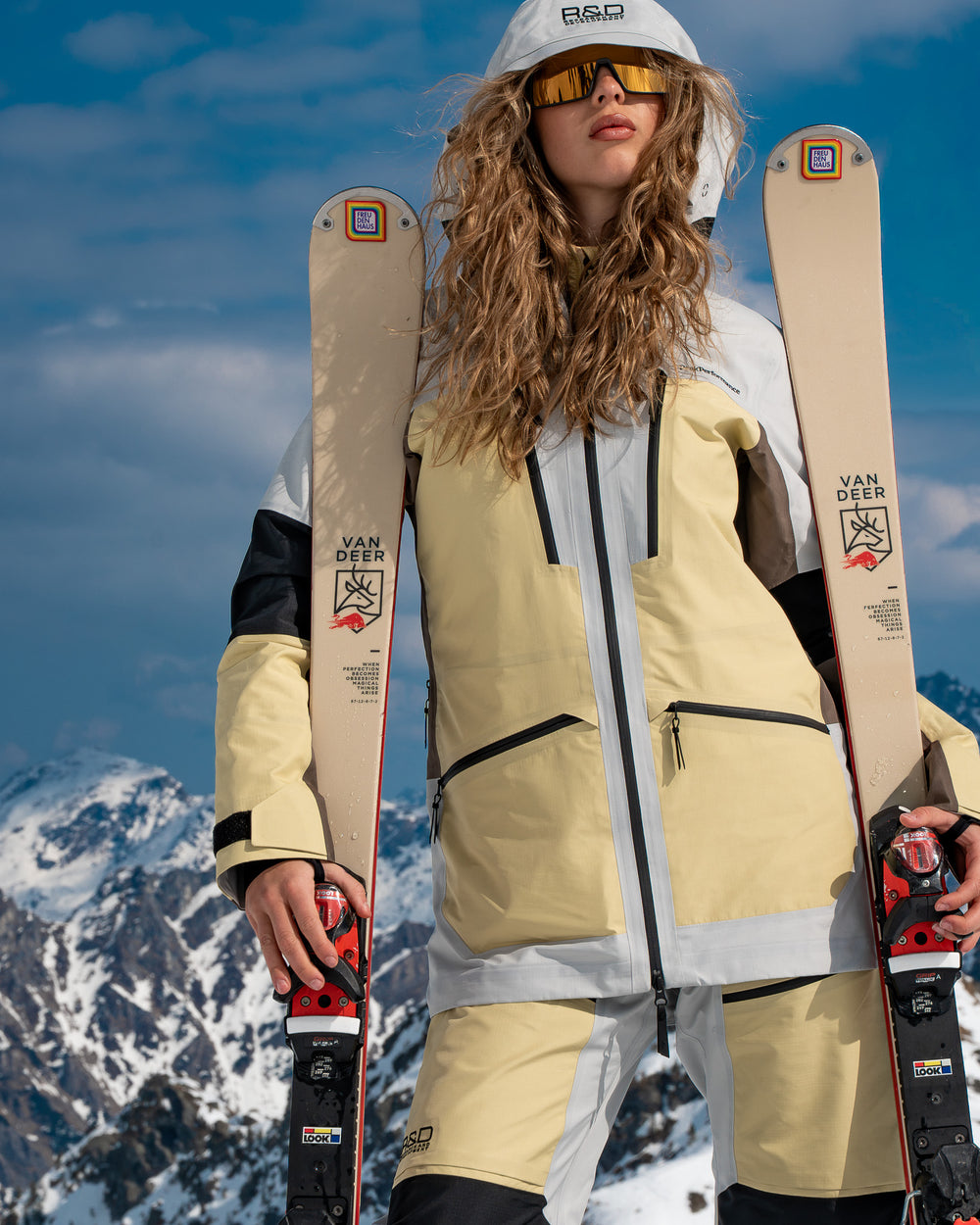
A real example is the VAN DEER H-POWER 89: The manufacturer states a waist width of 89 millimeters and positions the model between sporty piste skiing and variable conditions. This explains its place within this brand family. However, this does not imply a general recommendation that this width would be ideal for every all-mountain skier. Your requirements and the specific model must be considered together.
Understanding Sidecut and Radius Clearly
The sidecut describes the shape of the ski from above, i.e., the ratio of its widths along the ski. The stated radius helps to understand this geometry in terms of turn orientation. A smaller specified radius tends towards shorter turns, a larger one towards wider turns. However, it does not mechanically dictate that you can only make exactly one type of turn.
Pay attention to which length the specification applies to. For example, VAN DEER states different radii for different ski lengths for the H-POWER 89. The type of radius specification can also vary: Völkl describes several areas within its 3D radius geometry for the Mantra 88. A single number from two differently structured product descriptions is therefore not a complete direct comparison. First, assign the value to the respective model concept.
Understanding Rocker and Camber as Part of the Profile
The profile shows the ski from the side. With a rocker, the front or back section lifts earlier; pre-tensioning in the middle section is often referred to as camber. Manufacturers combine these elements depending on the desired character. Atomic explains rocker, among other things, as a feature that influences turning and use in softer snow. The specific design remains model-dependent.
For example, Völkl describes a tip-and-tail rocker with a camber shape in the middle for the Mantra 88. This information explains which profile parts come together. It is not a guarantee that every ski with the same terms will ski the same. Consider the length and distribution of the profile together with the construction and the intended target group. This turns a buzzword into a comprehensible selection aid.
Comparing Construction and Desired Feedback
Wood core, reinforcements, and sidewalls are among the specifications manufacturers use to describe their construction. What's interesting is not just the number of materials mentioned, but the intended orientation. One ski may be designed for direct feedback and sporty handling, another for a differently weighted compromise between maneuverability and support. The product description should make this role understandable.
Don't automatically confuse a more elaborate material list with the better choice for you. A model may require more active guidance than you find comfortable on a long day. Conversely, a significantly softer or less direct orientation may not suit your preferred skiing feel. Therefore, in the consultation, describe what you liked about your previous ski and what characteristics you want to change. Such observations are easier to categorize than a general desire for more performance.
Choosing Length Based on Model and Personal Prerequisites
Ski length does not only depend on body height. Skiing ability, weight, desired use, and the specific construction are also part of the decision. A more pronounced rocker and a differently designed ski can feel different at the same nominal length. A fixed formula for all all-mountain models would overlook these differences.
Compare the offered lengths with the recommendations of exactly this manufacturer and model. Include your actual abilities, not just your long-term goal. A ski should appropriately suit you today and allow for development, without the selection being based solely on the sportiest possible designation. If in doubt, a professional assessment of your personal prerequisites and the model is the better next step.
A Ski for Many Days or a Targeted Supplement?
If you only want to use one pair, it should suit the conditions you encounter most often. The rare exceptional day can play a role, but it should not automatically determine the entire decision. Consider what characteristics you appreciate on most descents and where you can consciously accept a compromise. This makes versatility concrete instead of boundless.
As a supplement to an existing piste ski, an all-mountain model can take on a different task. Then you don't have to cover the same characteristics twice. Compare the differences between both skis in width, profile, and orientation and determine when you would choose which pair. If this answer remains unclear, the tasks may overlap more than desired. A comprehensible division of roles facilitates selection.
Using Manufacturer Examples Correctly
VAN DEER describes the H-POWER 89 as a model with a strong all-mountain connection within its H-POWER series. Völkl categorizes the Mantra 88 for piste, mixed snow, and off-piste, among other things, and explains its own construction details for this. Such examples show that manufacturers implement versatility differently. They serve to understand the concepts and are not a general equation of the two skis.
For your purchase, the exact product version counts. Similar names can be used across multiple versions or model years; technical specifications should therefore match the item actually offered. Check length, geometry, and scope of delivery together. An official model description helps with classification but does not yet say anything about which specific variant you can currently choose in the shop.
Considering Binding and Ski Boot as a Combined System
A ski only becomes your setup together with suitable additional components. For ski bindings, among other things, the intended mounting system and the explicitly confirmed boot compatibility are crucial. A similar color or belonging to a brand family is not sufficient. Even a connection that seems mechanically possible is not yet proof of an approved combination.
Your ski boots should be included in this consideration regarding fit and suitability. Compile the specifications of existing components before selecting an addition. Qualified specialized personnel are responsible for professional mounting, adjustment, and function testing. This check remains necessary, even if an offer already describes skis and bindings as a complete set.
Comparing Scope of Delivery and Price on the Same Basis
Some offers refer to a ski without bindings, others to a defined system or package. Therefore, compare not only the visible price but also which parts are explicitly included. For the official Mantra 88 example, Völkl states a ski without included bindings; VAN DEER describes the H-POWER 89 with an associated FDT system. The specific execution of the respective dealer offer remains decisive.
Additionally, consider which existing components can be reused and are technically suitable for this. A combination that initially seems cheaper is not automatically the more sensible addition to your setup. If the scope of delivery and compatible parts are clear, the actual need can be credibly compared. You should only plan for mounting or service work if they are explicitly confirmed in the specific offer.
Correctly Comparing Weight Data
Weight data also needs a common reference. Check whether the manufacturer states a single ski or a pair, what length is assumed, and whether the binding is included. A value without this information can be misleading when comparing. Less weight is also not automatically the most important goal for every use. Categorize it according to how you transport the ski and what orientation you are looking for on the descent.
The Most Important Questions Before Your Decision
Finally, formulate your primary use in a few sentences: Where do you ski, what turns do you like, and what behavior do you expect from your next ski? Add body measurements, experience, and data of existing equipment. This makes a professional comparison much more concrete. Instead of collecting many models based on individual keywords, you can specifically compare a few suitable concepts.
Check whether the chosen length has the same characteristics that interest you in the model description. Always assign technical values to the correct item and separate the ski itself from the set scope. A suitable all-mountain ski does not have to maximize every conceivable task. It should meaningfully combine the conditions and the riding feel that most frequently define your own ski day.
04At FREUDENHAUS
05Questions about the category